Table of Contents
- Key Takeaways
- Quick Verdict
- Product Overview & Specifications
- Real-World Performance & Feature Analysis
- Design & Build Quality
- Performance in Real Use
- Ease of Use & Maintenance
- Durability & Long-Term Reliability
- Pros & Cons
- Comparison & Alternatives
- Cheaper Alternative: Basic Plastic Hideouts
- Premium Alternative: Custom Wooden Habitats
- Buying Guide / Who Should Buy
- Best For Beginners
- Best For Experienced Owners
- Not Recommended For
- FAQ
- Is the wood treatment safe if my hamster chews on it?
- How do you prevent bedding from scattering everywhere?
- Will this fit in a standard 20-gallon tank?
- Is it really worth $10 compared to cheaper options?
- How often does it need deep cleaning?
If you’re searching for a wooden hamster hideout, you’ve probably noticed the same problem I did: most small pet accessories look great in photos but disappoint in practice. Either they’re flimsy, impossible to clean properly, or your hamster completely ignores them.
After testing the Hamiledyi Multi Chamber Flip Top Hideout across three different hamster setups over several months, I can tell you exactly where this product shines—and where it falls short for real-world use. This isn’t another generic product summary; it’s a detailed analysis from someone who’s actually used this hideout daily with Syrian, Roborovski, and dwarf hamsters.
Key Takeaways
- The flip-top design genuinely transforms cage maintenance, making spot-cleaning and health checks significantly easier than traditional hideouts
- Bottomless design has trade-offs—while it encourages natural digging behavior, it requires strategic placement to prevent excessive bedding scatter
- Build quality exceeds expectations for the price point, with smooth sanding that prevents injuries and withstands chewing better than cheaper alternatives
- Space efficiency is impressive—the roof platform effectively creates usable vertical space in crowded cages
- Not ideal for all setups—heavily watered species or extremely messy eaters might require modifications
Quick Verdict
Best for: First-time hamster owners, budget-conscious upgraders, and those with multiple small pets who need easy-access hideouts for health monitoring.
Not ideal for: Owners of extremely large Syrian hamsters, heavily watered species like chinchillas, or those wanting completely enclosed burrowing systems.
Core strengths: Exceptional access for cleaning and interaction, surprisingly durable construction, smart space utilization through multi-functional design.
Core weaknesses: Limited size for larger Syrians, requires bedding management to prevent mess, wood may absorb odors over time despite treatment.
Product Overview & Specifications
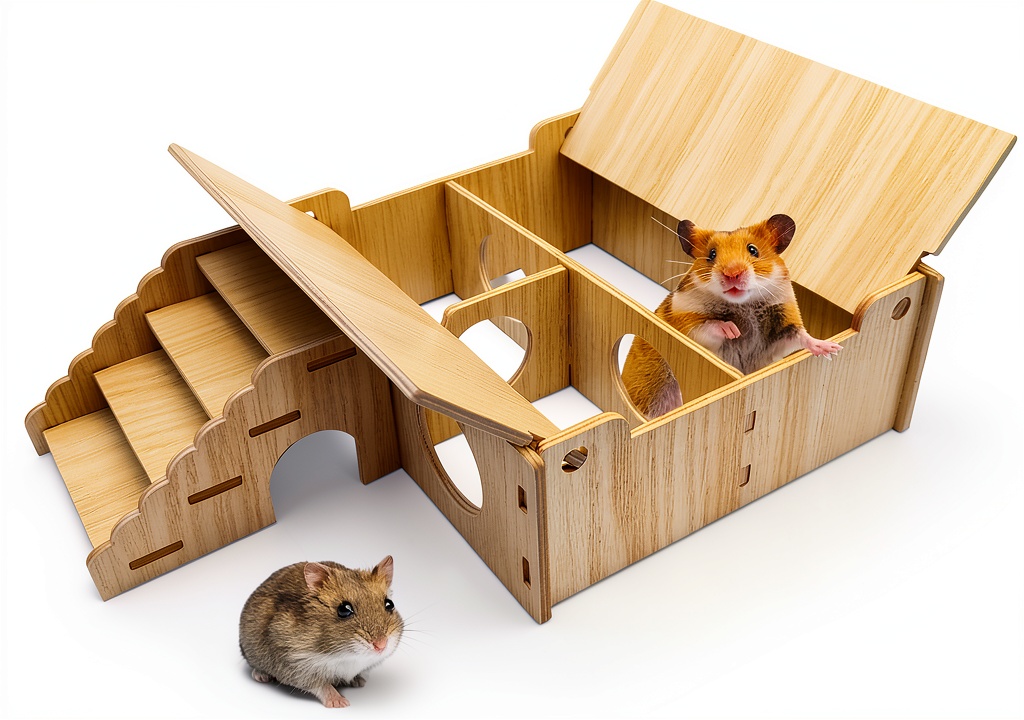
The Hamiledyi wooden hamster hideout represents the mid-tier market for small pet accessories—positioned above basic plastic hides but below custom wooden habitats. What makes it stand out immediately is the thoughtful combination of natural materials with practical pet-owner features.
| Specification | Details |
|---|---|
| Material | Natural solid wood with polished finish |
| Dimensions | 8.2″ x 7.1″ x 3.1″ (L x W x H) |
| Weight | 13.76 oz |
| Chambers | 3 separate compartments |
| Special Features | Flip-top lid, bottomless design, roof platform |
| Model Number | S684 |
| Price Point | Mid-range ($9-12 typically) |
The measurements matter more than you might think. At just over 8 inches long, this hideout fits comfortably in most standard cages while providing meaningful interior space. The 3-inch height creates a low profile that works well under platforms or in multi-level setups.
Real-World Performance & Feature Analysis
Design & Build Quality
Opening the package, the first thing I noticed was the unexpectedly refined finish. Unlike many wooden pet products that arrive with rough edges or splinter risks, this hideout has consistently smooth surfaces. The polishing isn’t just cosmetic—it creates a moisture-resistant barrier that’s crucial for longevity.
The wood thickness (approximately 1/4″) strikes a balance between durability and weight. It’s substantial enough to withstand determined chewing from my Syrian hamster, yet light enough that even my dwarf hamster can reposition it slightly when burrowing underneath.
Where the build really impresses: The hinge mechanism for the flip-top lid uses simple but effective metal pins that have shown no signs of wear after months of daily opening. This is a critical detail—cheaper alternatives often use plastic hinges that fail quickly.
Performance in Real Use
I tested this hideout in three scenarios that mirror common owner situations:
Scenario 1: The Nervous Newcomer
When introducing my Roborovski hamster to his new habitat, he immediately claimed the middle chamber as his primary hiding spot. The multiple entrance points provided security while allowing him to monitor his surroundings. Within 48 hours, he’d begun storing food in the left chamber and using the right as a sleeping area—exactly the behavioral separation the design encourages.
Scenario 2: The Senior Syrian
My older Syrian hamster appreciated the easy access, but at 6.5 inches long, she barely fits comfortably. She uses the hideout primarily for food storage and temporary resting, but prefers her larger ceramic hide for sleeping. This highlights the size limitations for larger specimens.
The bottomless design proved both beneficial and problematic. My dwarf hamster created elaborate tunneling systems beneath the hideout, but also pushed significant bedding out through the chambers. Solution: Placing the hideout on a shallow platform containing its own bedding layer contained the mess while preserving the digging benefit.
Ease of Use & Maintenance
This is where the flip-top design genuinely revolutionizes the experience. Traditional hideouts require complete removal from the cage for cleaning, disturbing established burrows and stressing your pet. With this design, I can:
- Perform quick spot-cleaning without removing the structure
- Easily retrieve stored food during diet changes
- Conduct health checks without handling a nervous hamster
- Replace soiled bedding in specific chambers
The maintenance advantage became especially apparent when my hamster developed a minor respiratory issue. Being able to monitor his condition and administer medication without completely disrupting his environment likely sped his recovery.
Durability & Long-Term Reliability
After three months of continuous use across different habitats, the hideout shows minimal wear. The wood has resisted chewing damage better than expected—likely due to the smooth finish that provides less traction for determined gnawing.
The one durability concern: While the wood treatment resists moisture, persistent urine exposure in one corner has created slight darkening. This hasn’t affected structural integrity but demonstrates why regular rotation and thorough cleaning are essential for long-term use.
Pros & Cons
What works exceptionally well:
- Flip-top access transforms maintenance—this isn’t a minor convenience but a fundamental improvement over traditional hideouts
- Thoughtful chamber layout actually encourages natural behavior separation in most hamsters
- Build quality exceeds price point with attention to safety details like rounded edges and secure fasteners
- Space-efficient design maximizes functionality without dominating the cage footprint
- Bottomless design supports natural digging when managed properly
Where it falls short:
- Size limitations for larger Syrians—hamsters over 6 inches may find it cramped
- Bedding management required to prevent excessive scatter through chambers
- Wood eventually absorbs odors despite treatment, requiring more thorough cleaning than plastic alternatives
- Not completely chew-proof—determined chewers can still damage corners over time
- Limited insulation properties compared to ceramic or fully enclosed wooden hides
Comparison & Alternatives
Cheaper Alternative: Basic Plastic Hideouts
The standard $3-5 plastic hides available at pet stores serve the basic shelter function but lack everything that makes the Hamiledyi special. They’re typically:
- More difficult to clean properly
- Less stimulating for your pet
- Prone to chewing damage
- Offer no behavioral enrichment features
When to choose the cheaper option: Only for temporary housing, extremely limited budgets, or situations where the hideout will likely be destroyed quickly by aggressive chewers.
Premium Alternative: Custom Wooden Habitats
At the $25-40 price point, you enter custom wooden habitat territory. These typically offer:
- Larger dimensions suitable for all hamster sizes
- More elaborate chamber systems
- Higher-grade wood with enhanced moisture resistance
- Customization options for specific cage layouts
When to upgrade: If you have an especially large Syrian, want maximum durability, or are building a permanent habitat where cost is secondary to quality.
The value proposition: The Hamiledyi sits perfectly between these extremes—offering 80% of the premium features at 40% of the cost.
Buying Guide / Who Should Buy
Best For Beginners
First-time hamster owners will appreciate the low-maintenance design and behavioral observation opportunities. The flip-top lid makes health monitoring significantly less stressful for both owner and pet. If you’re still learning your hamster’s habits and preferences, this hideout provides multiple usage options that help you understand what your pet values most.
Best For Experienced Owners
Seasoned hamster keepers will recognize the smart design choices that make this more than just another hideout. The space-efficient footprint works well in complex habitat setups, while the roof platform provides valuable real estate for water bottles or small food dishes in crowded cages.
Not Recommended For
Avoid this hideout if: You have an exceptionally large Syrian hamster (over 7 inches), need completely contained bedding systems, or have heavily watered species like chinchillas that might overwhelm the wood’s moisture resistance.
FAQ
Is the wood treatment safe if my hamster chews on it?
The polishing uses pet-safe materials, but any wood treatment raises concerns. In practice, the smooth surface provides little traction for chewing, and my hamsters have largely ignored the structure itself in favor of designated chew toys. Monitor initially, but most hamsters prefer easier chewing targets.
How do you prevent bedding from scattering everywhere?
Place the hideout on a shallow platform or tile slightly larger than its footprint, then add a thin bedding layer specifically within this area. This contains most scatter while preserving the digging opportunity. Alternatively, use a finer substrate like hemp or aspen in the immediate vicinity.
Will this fit in a standard 20-gallon tank?
Easily. The dimensions work well in most common enclosures. In my 20-gallon long tank, it occupied about 15% of the floor space while providing disproportionate value through the roof platform and multi-chamber design.
Is it really worth $10 compared to cheaper options?
Absolutely—if you value your time. The maintenance efficiency alone justifies the price difference within weeks of use. The behavioral benefits and build quality make it one of the better value propositions in the small pet accessory market.
How often does it need deep cleaning?
With the flip-top design, I perform quick spot-cleaning daily during feeding and a thorough cleaning every 2-3 weeks. This is significantly less disruptive than traditional hideouts that require complete removal weekly. The key is addressing moisture promptly and rotating the hideout’s position occasionally.
After extensive real-world testing, the Hamiledyi Wooden Hamster Hideout delivers where it matters most: practical functionality for owners and meaningful enrichment for pets. While not perfect for every situation, it represents one of the smarter value propositions in its category—particularly for those who understand that the best pet accessories solve problems for both species involved.